Calm 2027 vision board ideas for people who are already tired
Most vision boards ask you to want more of everything. Here is a slower way to make one: three priorities, a not-to-do list, a weekly energy budget and a board you can build in one evening without magazines.
A board with forty pictures of beaches, promotions and morning routines can look lovely on a wall and still leave you tired by February. The board never asked how many of those things a normal week can hold. The answer is fewer than we hope, and a vision board that ignores it turns into one more list you feel behind on.
These are the ideas I would use if I were making a 2027 board for someone who already has a full life. They work with a printer, with magazines or with a pen and a sheet of paper.
1. Start with the year you had
A board works best when it grows from the year you actually lived, so spend ten minutes on 2026 first. Write down what carried you, what cost more than it gave, what surprised you and what you are glad is over. Then finish this sentence: "If 2026 were a weather forecast, it would be..." People are usually honest about weather, and the answer tells you quickly whether 2027 needs more ambition or more rest.
2. Check eight life areas by energy
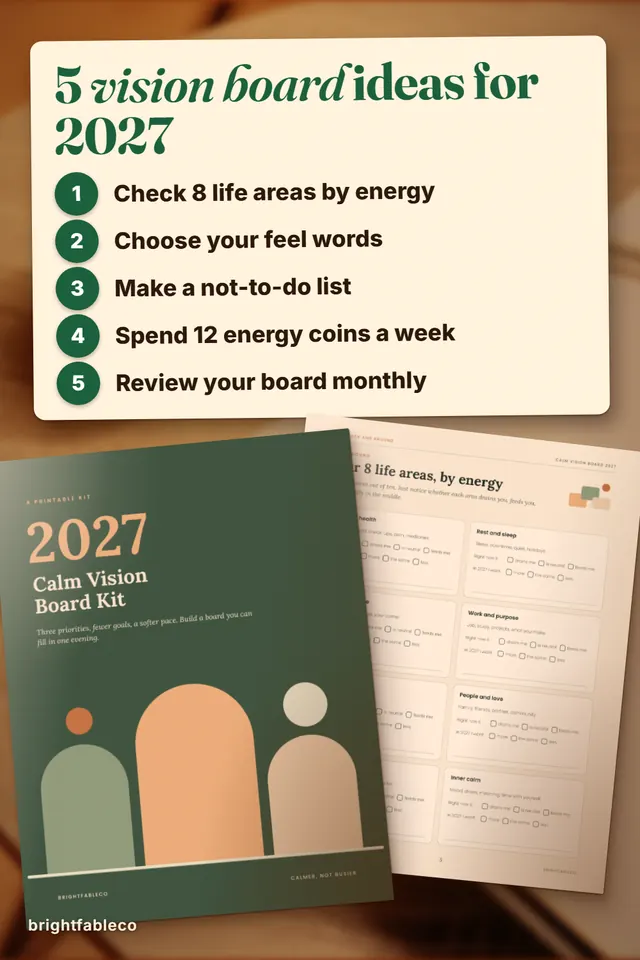
Skip the scores out of ten. For each area, write only whether it drains you, feeds you or sits in the middle, and whether you want more, the same or less of it in 2027. The eight areas I use are body and health, rest and sleep, home and space, work and purpose, money and security, people and love, play and joy, and inner calm.
Look at the result before you set a single goal. If five areas drain you, a board full of new projects will not help, but a board that protects sleep and removes one obligation might.
3. Pick three priorities, and make them specific
Three is the limit, and it works better as a ceiling than a starting point. For each priority, answer four questions: why this and why now, what "enough" looks like, what the first tiny step is (under 20 minutes), and what you will let slide to make room.
Here is an example. Suppose your priority is "get the spare room usable". Why now: you keep avoiding it and it follows you around. Enough: a desk, a lamp and a clear floor, with no new furniture. First step: carry out one bag of things for the charity shop. Let slide: the garden, until May. That is a priority a Tuesday evening can touch. "Improve my home" is not.
The "let slide" line does most of the work. If you cannot name anything you would drop, the priority is too big or you have too many.
4. Choose feel words before pictures
Goals are often a way of chasing a feeling, so pick the feeling first. Choose three words for how you want your days to feel, such as calm, unhurried, steady, spacious, warm, playful or grounded. Then add the sentence "By December 2027 I want my days to feel ___, and to get there I will need more ___."
These three words become the filter for everything that goes on the board. A photo of a crowded rooftop party might look exciting, but if your words are "unhurried" and "steady", it does not belong.
5. Write a not-to-do list
What you stop doing makes a calm year as much as what you start. Write down what you are not doing in 2027 and what you will do instead. A few examples to borrow: answering messages after 8 pm, saying yes before checking my energy, scrolling in bed, taking on other people's deadlines, skipping lunch to finish one more thing, apologising for resting.
Add one line of permission at the bottom, such as "I give myself permission to leave the dishes until morning". It sounds small, but it is often the line that helps most.
6. Spend 12 energy coins
A week holds less energy than a to-do list pretends. Draw 12 coins and shade them across five buckets: your three priorities, work and obligations, people you love, rest and recovery, and joy and play. Keep a spare buffer for the unexpected. My rules: at least two coins go to rest, at least one stays free, and if your priorities need more than four coins, one of them is too big.
Your budget will shift with the seasons, so redo it each month. In a heavy work month your priorities may get two coins, and that is allowed.
7. Build the board without photos
Now the fun part, and it should be the shortest part. You will need scissors, a glue stick or tape and a pen. Have your three priorities, feel words and not-to-do list beside you, then choose one of three layouts:
- The grid: twelve even frames, good if you like order. Leave some frames empty on purpose.
- Collage cells: mixed sizes and colour blocks, good if you like play.
- One-page minimal: a single frame with lots of air and your three priorities along the bottom.
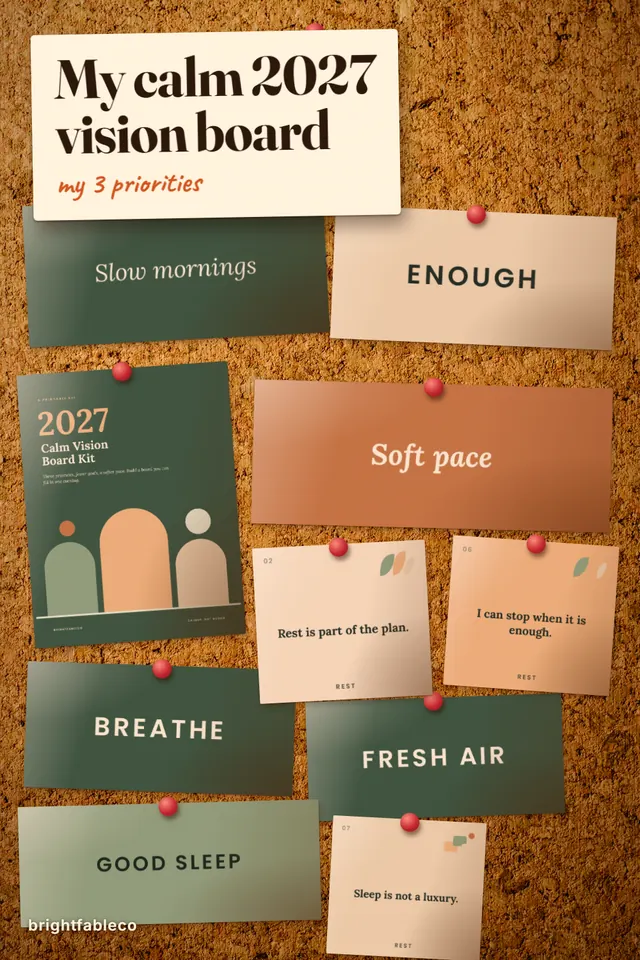
Fill it with words, colour blocks and shapes rather than pictures. Short phrases are easier to live with than photos of other people's lives: "slow mornings", "enough", "soft pace", "good sleep", "fresh air". Aim for 8 to 15 pieces, not 40. Lay everything out before gluing, and glue only when the arrangement looks calm to you.
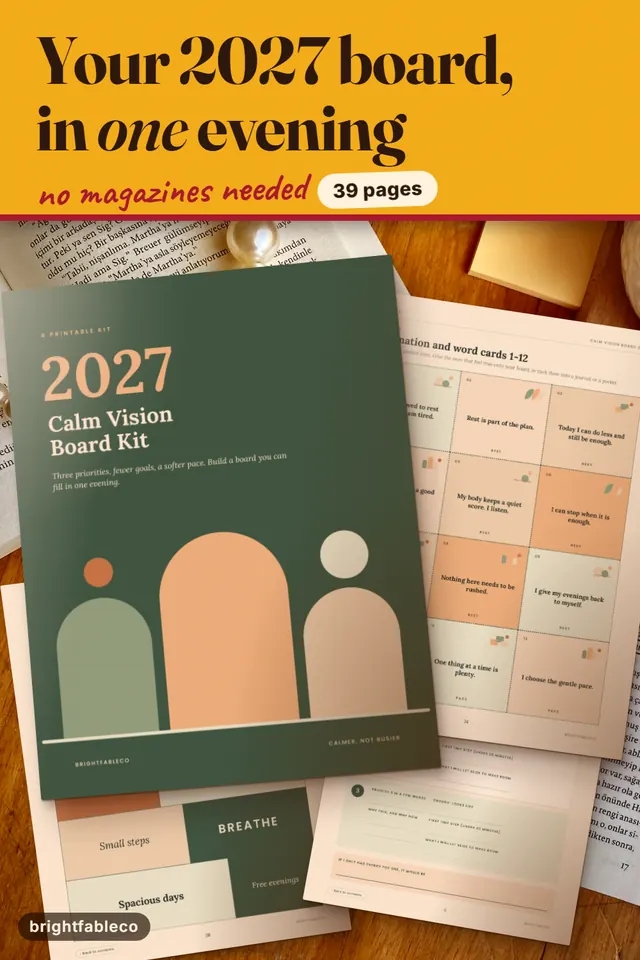
This is the exact process I built into the 2027 Calm Vision Board Kit, so you do not have to draw frames or write your own prompts. It comes with 60 cut-out cards in six groups, from rest and pace to boundaries and kindness, 40 phrase tiles, and the three layouts above. Plenty of people will do the same thing with plain paper, and the steps above are enough to try it that way first.
8. Keep it alive through 2027
A board does its work after the evening you build it. Hang it somewhere you pass every day. Once a month, give it ten minutes: do the three priorities still fit, what could come off, what should be added, and how did your energy run? Every quarter, decide kindly whether each priority stays, gets tweaked or is swapped. Think of the board as a compass. You are allowed to change it in June.
Two other pieces fit well here. A single word gives the board a caption, and our guide to choosing a word of the year for 2027 shows how to find one in about 20 minutes. When the priorities need actual dates, a 90-day plan turns each one into weekly steps.
If you like to think out loud, an AI assistant can help with the sorting. Paste in your messy list of wants and ask it to put five questions to you, one at a time, so you can choose your three. Leave out names and private details, and treat the answers as questions to think about. The free Calm AI Prompt Pack below has prompts like that, and the kit has an optional page with three.
One practical note on timing: if December is crowded with hosting, make the board on a quiet evening in January instead. And if you are running a family night first, our screen-free Christmas Eve ideas can take care of that evening so this one stays free. You can see everything else I make on the shop page.
FAQ
How many things should be on a vision board?
Fewer than you think. I suggest three priorities and 8 to 15 pieces on the board itself, with gaps left on purpose. Each extra priority makes the others quieter.
Can I make a vision board without photos or magazines?
Yes. Words, colour blocks, simple shapes and short phrases work well, and they are quicker to arrange than cut-out pictures. Add your own photos if you want them, but the board does not need them.
When is the best time to make a 2027 vision board?
Any quiet evening from December onward. Many people use the days between Christmas and New Year, but a board made on 15 January works just as well. What matters is that you can spend about an hour without interruptions.
What do I do with the board once it is finished?
Put it where you will see it without effort, such as beside your desk or on the inside of a wardrobe door. Once a month, spend ten minutes asking whether it still fits, and swap or remove anything that no longer does.
Is this the same as manifesting?
No. A calm board is a planning aid: it shows what you chose to give your limited energy to, and what you chose to leave alone. It makes no promise that wishing will bring results, and it is not therapy or financial advice.