A 90-day goal plan for 2027: turn three goals into weekly actions
A year is too long to plan and a day is too short to matter. Ninety days sits in between. Here is how I turn three goals into weekly actions, review them in 20 minutes and start the next sprint with fresh eyes.

The usual pattern with a yearly goal list goes like this. In January you write ten goals and feel good. In March you look at the list and feel behind, and by June you have stopped looking. Often the size of the plan is what breaks it: it asks you to hold a year in your head and gives you no way to see progress along the way.
A 90-day sprint fixes the size problem. It is about 13 weeks, which is the length of a calendar quarter. Short enough to see the end from the start, long enough for a real result.
Step 1: choose three goals
Brainstorm everything you would like to happen in the next quarter, with no filter. Then narrow the list to three. For each candidate, ask whether it matters to you in the next 90 days or whether it would just be nice. If you are stuck, the process in our calm vision board article helps, because it makes you choose three priorities by energy rather than by ambition.
Make one of the three small enough to finish. A short win in the first month keeps the other two going.
Step 2: define done and the first step
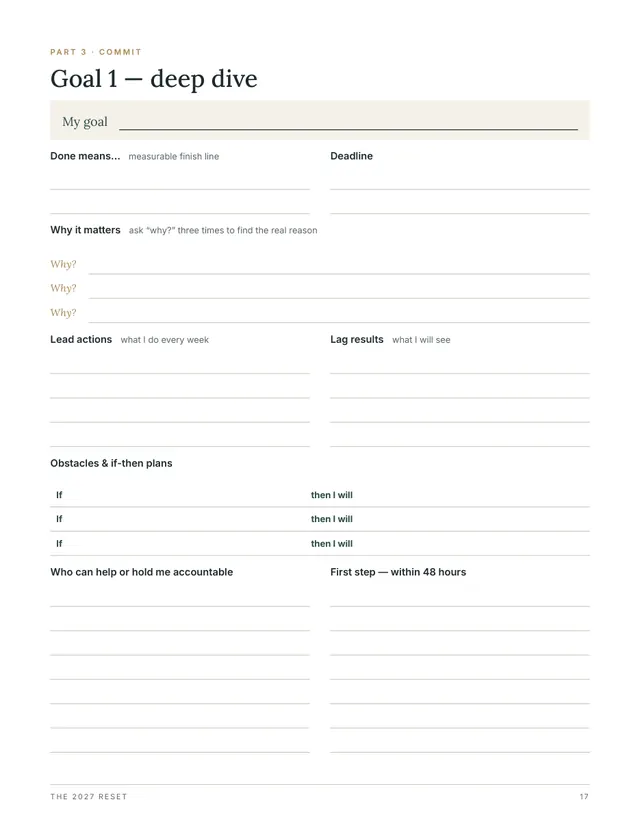
For each goal, write three things.
- Done means: a measurable finish line and a date. "Run 5 km without stopping by 31 March" is clear. "Get fitter" is not.
- Why it matters: ask "why?" three times to find the real reason. The first answer is usually the polite one.
- The first step, within 48 hours: something that takes under an hour and is easy to start.
Add one if-then plan for the obstacle you expect. "If it is raining on a run day, then I will do the indoor routine." You are not trying to predict every problem. One prepared answer to the likeliest one is enough.
Step 3: pick weekly lead actions
This step carries the plan. A lag result is what you want to see at the end, such as a finished draft. A lead action is what you do each week to cause it, and it is entirely in your control. You cannot control whether a draft turns out well. You can control whether you sit down for three 45-minute sessions.
Give every goal one lead action per week, or two at the very most. Three goals with two actions each is already six things to do every week, which is plenty alongside a normal job and family.
Examples of how it looks:
- Goal: finish the first draft of my course. Lead action: three 45-minute writing sessions per week.
- Goal: run 5 km without stopping. Lead action: three runs per week, adding a few minutes each time.
- Goal: clear the spare room. Lead action: one box or one shelf each Saturday morning.
Step 4: lay out the 13 weeks
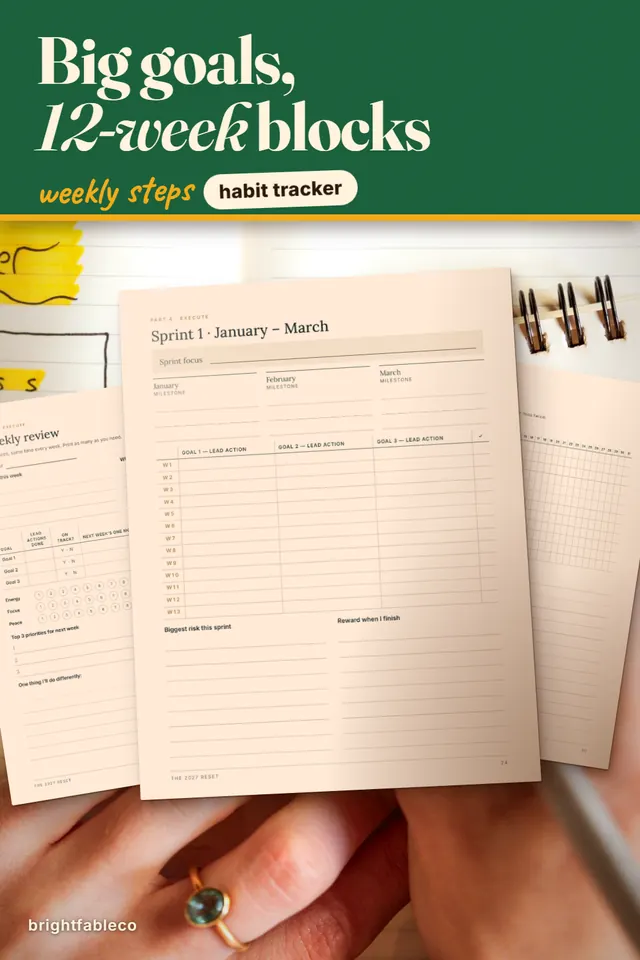
Write the three months across the top and give each a milestone, one line per goal. Month one might read: course outline done, running 2 km without stopping, one corner of the room clear. Under the milestones, number the weeks 1 to 13 and write each week's lead action beside its goal, adjusting as you go.
The planner I make has 13 week rows on each sprint page, which matches a calendar quarter. My own habit is to treat weeks 1 to 12 as work weeks and week 13 as a buffer for catching up and reviewing, which is how a 12-week plan fits inside a 13-week quarter. Use the thirteenth week however it helps you most. Also write the biggest risk for this sprint (a busy period at work, a holiday) and a reward for finishing. A planned reward makes the finish line more concrete.
A realistic week under this plan looks modest, and that is the idea. Monday morning you glance at the three lead actions. During the week you do them in the gaps you protected: two evening writing sessions, a run before breakfast, ten minutes with one shelf. On Friday or Sunday you spend 20 minutes on the review. If a week goes wrong, you write down why and carry one move into the next week. Nothing in that routine depends on motivation on the day, as long as the actions are small, scheduled and written where you can see them.
If you start in December, treat the weeks around Christmas as light weeks, and plan one lead action per goal at most. If you run a family evening, our guides to Christmas party games and screen-free Christmas Eve ideas can take the planning off your plate so the sprint does not compete with it.
Step 5: review weekly and monthly
The plan survives because of the weekly review. Take 20 minutes, at the same time every week:
- Write your wins for the week and what did not go to plan, and why.
- For each goal, record whether you did the lead action and whether you are on track.
- Choose next week's one move for each goal and your top three priorities.
- Block time for deep work, then rate your energy, focus and peace from 1 to 10 so you notice patterns.
Once a month, take a longer look at progress for each goal and ask what is working and what you will change. Ask yourself whether you acted like the person you are becoming, and where not yet. If you also track a habit, tick it daily and follow one rule: never miss twice.
Step 6: close the sprint
At day 90, hold a sprint review. Celebrate first, because it is easy to skip. Write what you achieved, what to keep doing and what to stop or change. Then ask whether your three goals are still the right ones. Sometimes a goal turns out to be the wrong one, and you swap it. Sometimes it is nearly done and moves to maintenance. Then start the next sprint with fresh goals and a short list of what you learned.
A word can help hold all four sprints together. Our guide to choosing a word of the year shows how to pick one that you can check each week.
Print the pages or draw them yourself
You can run all of this in a notebook with ruled columns. If you would rather have the pages ready, the 90 Day Goal Planner contains the four sprint pages, the weekly and monthly reviews, the habit tracker and the sprint review. The sprint pages are the same ones that close the 2027 Goal Setting Workbook. That workbook comes first in the process: it adds the year review, the wheel of life, three goal deep dives, a fear and resistance audit and keystone habits, so choose it if you want to decide the goals before you schedule them. You can browse everything in the shop.
FAQ
Why 90 days instead of a full year?
Ninety days is long enough to make visible progress and short enough that you can still remember the start. A year-long plan tends to be revised in March, so it helps to plan one quarter at a time.
How many goals should I work on in one 90-day sprint?
Three at most. Each goal needs weekly attention, and most people find a fourth one pushes something else out. If you have more than three, keep the rest on a "later" list.
Do I have to start on 1 January?
No. A sprint can start on any Monday. Starting in December works if you treat the holiday weeks as light, and starting later in January works too. The four sprints in the planner run January to December, but you can shift the dates.
What is the difference between a lead action and a goal?
A goal is the result you want, such as a finished draft. A lead action is the thing you do each week that you control, such as writing for three 45-minute sessions. You track lead actions every week, and the result follows.
What if I fall behind in the middle of a sprint?
Do the weekly review anyway and pick one move for next week. Missing one week matters little, and the rule I use in the habit tracker is never to miss twice. At the end of the sprint, adjust the plan rather than abandoning it.